
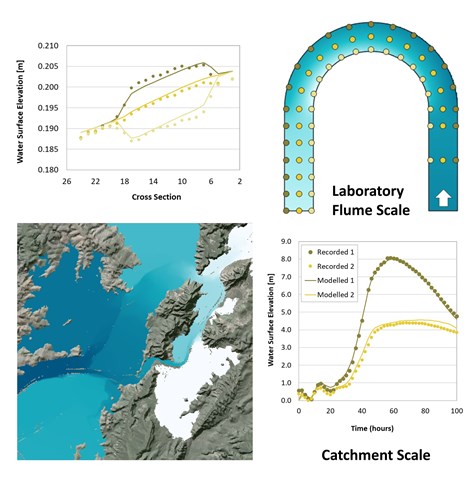
From the deep ocean to laboratory flumes, TUFLOW's flexible mesh engine TUFLOW FV covers all bases including sediment, morphology, water quality and particle tracking simulation.
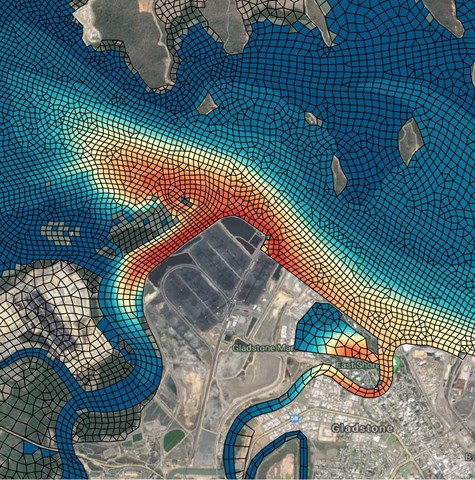
Our flagship 2D/3D flexible mesh solver, TUFLOW FV, permits use of freely oriented triangular and quadrilateral elements to simulate environmental flows, breaking the shackles of fixed grid modelling. TUFLOW FV allows models to conform to nature's shapes, rather than artificially forcing nature to fit a fixed grid solution.
TUFLOW's flexible mesh solver, together with its suite of environmental modules - including advection dispersion, sediment transport (with morphological update), water quality and particle tracking - provides the power needed to tackle the most challenging environmental modelling problems from oceans to urban lakes.
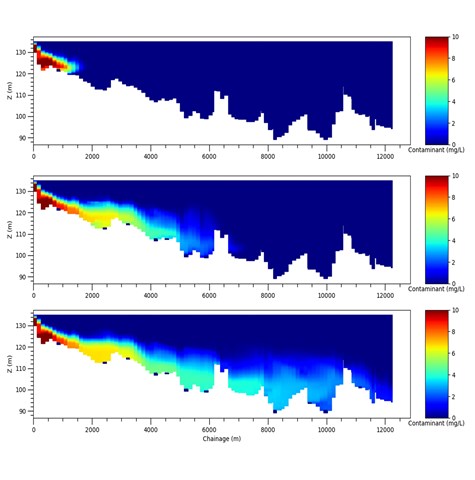
TUFLOW FV delivers world-class 2D and 3D hydrodynamic modelling that includes:
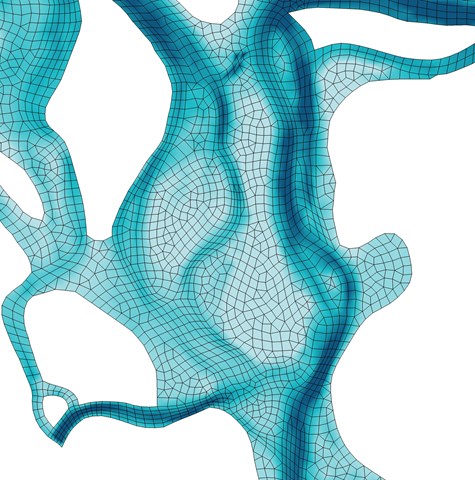
TUFLOW's flexible mesh means that constraints of fixed grid models - such as long run times due to unwanted spatial resolution - are a thing of the past. TUFLOW's flexible mesh allows unrestricted use and orientation of quadrilateral and triangular cell sizes within a model domain so that spatial resolution can be varied across a model at will. This means:
In short, this flexible mesh approach means faster run times and less memory use, and ultimately, faster project delivery.
TUFLOW FV is optimised for parallel CPU and Cloud compute, on Windows and Linux platforms. This offers the flexibility needed to efficiently execute complex environmental modelling projects.
In addition, TUFLOW's flexible mesh model is executable on GPU, either locally or in the Cloud. Testing has shown that TUFLOW's GPU acceleration provides speed gains of up to 40 times over traditional single core CPU implementations.
This acceleration is a game-changer for environmental modelling: simulations that previously took days of elapsed time can now be executed in a matter of hours.
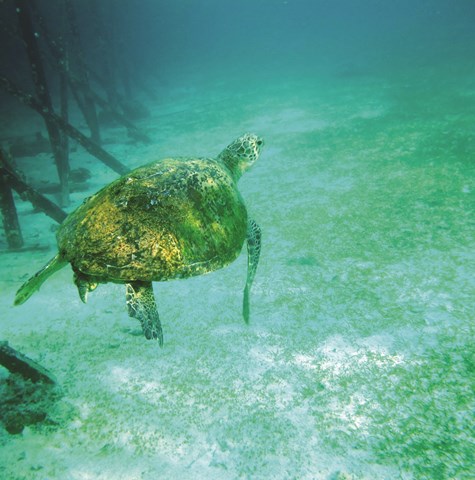
TUFLOW FV isn't just a great hydrodynamic solver, it also includes all the environmental modelling add-ons needed to tackle the most challenging estuarine and coastal modelling studies. These include:
In addition, a wealth of Python and MATLAB tools and GIS plugins are available to make modelling with TUFLOW FV satisfying and rewarding.
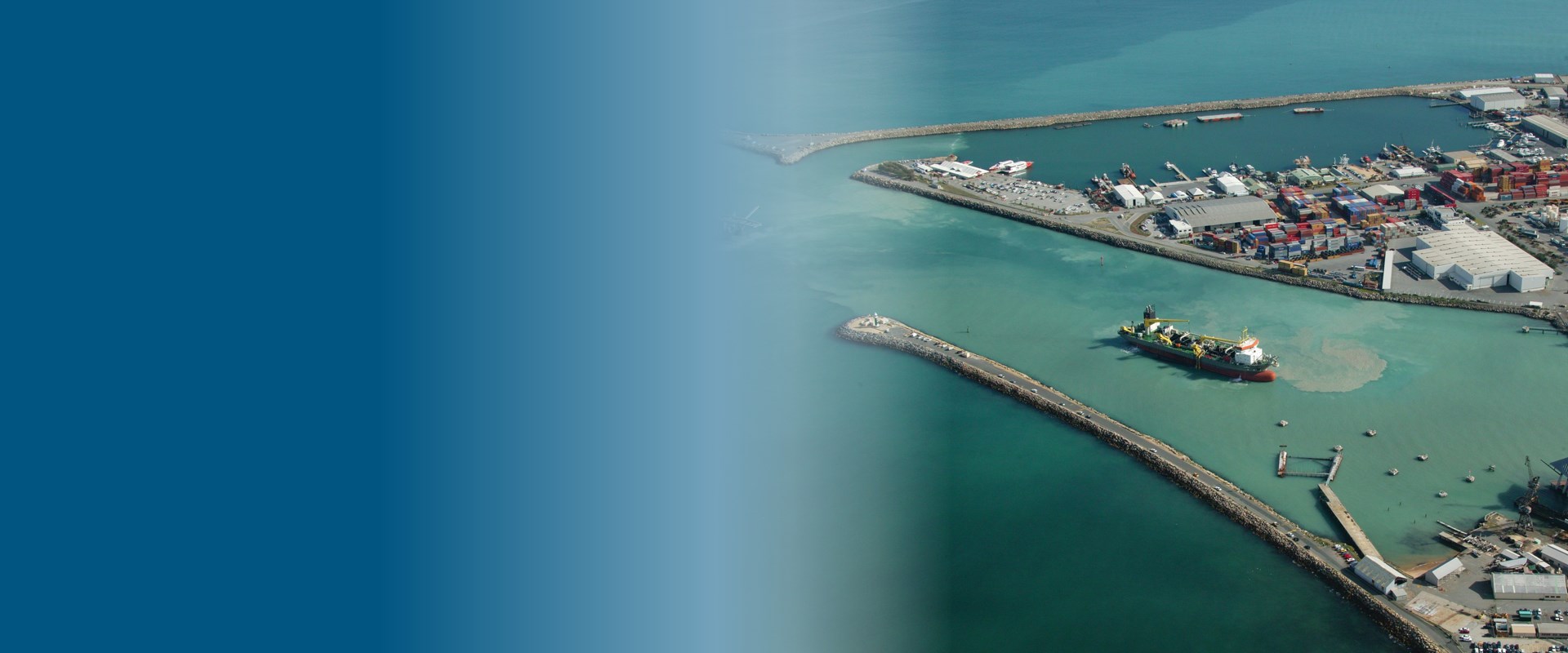
With its flexible mesh approach, TUFLOW FV is able to easily simulate fluid mechanics across a wide range of physical scales, from metres all the way up to hundreds of kilometres in the open ocean. Some applications of TUFLOW, such as port dredge plume assessments, encompass this entire range of scales in a single model, and do so with ease.
Other applications of TUFLOW that have successfully exploited this ability include simulation of sinuous estuaries that discharge to the open ocean, water supply reservoirs that need detailed resolution only around destratification structures, and open ocean outfall assessments.
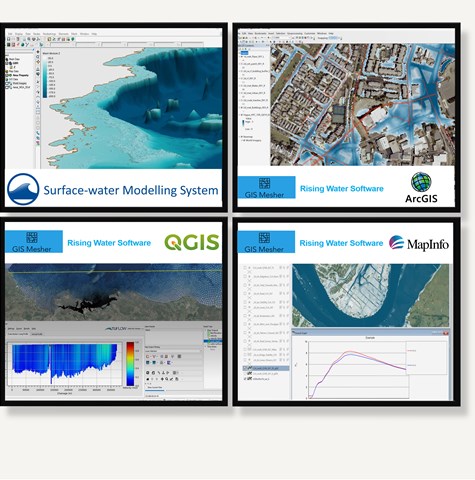
TUFLOW's flexible mesh solver can be integrated within Graphical User Interfaces such as Aquaveo's SMS, or Geographical Information Systems such as ArcGIS/ArcPro, MapInfo and QGIS. This allows TUFLOW to blend with existing user workflows, and also means that licence costs are kept down: users are purchasing world class engines that can be used seamlessly with specialist visualisation packages.
Simulation output formats are selectable to match these platforms and can be easily and efficiently post-processed using Python or MATLAB to meet project or user needs.